

Why are many Digital Transformation initiatives failing?

Portfolio Management with SAFe®: how to make It work in practice?
In a context characterized by processes with greater technological integration and increasing concerns about information security, IT Governance stands out as a critical pillar to ensure alignment between decision-making and the medium- and long-term objectives of organizations.
Designing and sustaining effective governance that enhances value creation and provides guidance for IT-related decisions remain challenges for many organizations, particularly when it comes to defining decision rights and responsibility structures.
So, how can an IT Governance decision-making model be developed, distributing decision-making authority throughout the organization? In the video below, we present the five most common models in organizations based on best practices in the field:
The five most common models in organizations based on IT Governance best practices
Case study: how to define IT Governance Archetypes for each type of decision?
As shown in the video above, there are several possible IT Governance archetypes that outline combinations of contributors and decision-makers for IT-related decisions. In practice, how can archetypes be defined for each type of decision?
Below, we share a model to assist in this structuring:
Interview with the board of directors to gather strategic aspects of the company and IT principles.
Interview with business managers to identify key challenges in project prioritization with IT.
Identification of gaps and future vision expectations.
Definition of IT Governance decision rights.
Source: Bridge & Co., 2022
The model was used to assist a mid-sized client, who had a lean IT structure and outsourcing strategies to build the team, in structuring the decision rights related to the use of IT.
The interview phase was used to map the main challenges faced by the executive and business management teams regarding the topic within the organization. Based on the results, we share the key points identified:

- Ineffective portfolio management with project replanning and shifting priorities without a clear understanding of the decision-making criteria, resulting in dissatisfaction among business areas and compromising IT capacity.

- Lack of governance principles for IT decisions, such as make or buy, on-premise or cloud, and Information Security.

- Limited automation of routine activities, compromising productivity and efficiency.

- High dependency on IT support for the technical design of solutions.
Considering the organization's characteristics and using the proposed model, it was possible to establish a governance arrangement with the decision rights defined as follows:
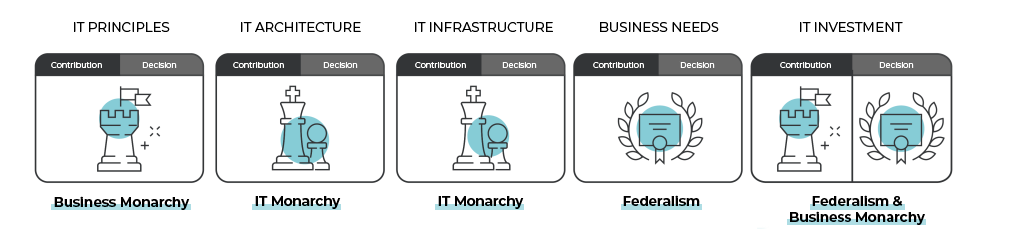
Source: Bridge & Co., 2022
Based on this arrangement, it was defined that:
- IT principles based on the business monarchy archetype, meaning IT is responsible for contributing ideas, benchmarks, and positions regarding IT principles, while the executive board is responsible for making decisions and approving them.
- IT architecture and infrastructure based on the IT monarchy archetype, where IT itself is responsible for gathering and proposing the design of IT architecture and infrastructure, with the decision-making responsibility lying with the IT executive board.
- Business needs based on the federalism archetype, meaning all areas, whether business or IT, must be involved in decision-making to support the organization’s strategic objectives.
- IT investments based on the federalism archetype for contribution, where all units must participate in defining and identifying the necessary investments, and the business monarchy archetype for decision-making, with the executive board being responsible for determining the available CAPEX budget for IT.
Benefits generated from defining decision rights
As benefits from the definition of decision rights presented, we share:

The establishment of a decentralized IT Governance model for capturing and analyzing business needs, aligned with market best practices.

Greater engagement of business areas in building the project portfolio.

Empowerment of business areas in technology initiatives, aligned with IT guidelines and standards.

More proactive involvement of IT in identifying improvement opportunities with technology solutions.
The example presented aims to clarify how existing models can be applied in practice. However, we emphasize that this choice should consider the specific characteristics of each organization, such as size, industry, and adopted business strategy. It is important to address different hierarchical levels and areas in order to obtain a holistic view of gaps and expectations.
Contact one of our experts to learn how Bridge & Co. can support your organization.