

Customer Centricity: the challenge of keeping a customer-focused strategy

Organizational Redesign: when and how to do it?
Intelligent Agents represent an evolution in the integration between automation and Artificial Intelligence (AI). In terms of autonomy and action capability, they stand at the third level of agency compared to traditional robotic automations (RPA) and smart assistants like Google Assistant or Alexa.
In this article, we explore short-term applications that companies can benefit from through the adoption of intelligent agents.
What is an intelligent agent and how does it work?
These agents are characterized by their high level of agency. They combine perceptive capability, apply advanced learning techniques, and operate autonomously — interacting with other agents, legacy systems, websites, applications, and any other resources required to make decisions and deliver the results requested by their creator (referred to as the Principal according to Agency Theory).
In other words, an intelligent agent differs from robotic automation because it does not follow a predefined step-by-step sequence. It is not limited to merely responding to questions or executing specific actions. Instead, the agent receives instructions regarding tasks to be performed and objectives to be achieved through prompt engineering. From that point, it uses language models and establishes the necessary connections to interact with the largest possible volume of data, systems, and other agents, allowing it to make decisions that were not preconfigured—an important aspect to highlight.
Ultimately, the intelligent agent delivers a result. The effectiveness of that result depends directly on the quality of the prompt, the extent and quality of the agent’s training, and the AI and LLM (Large Language Model) to which it is connected.
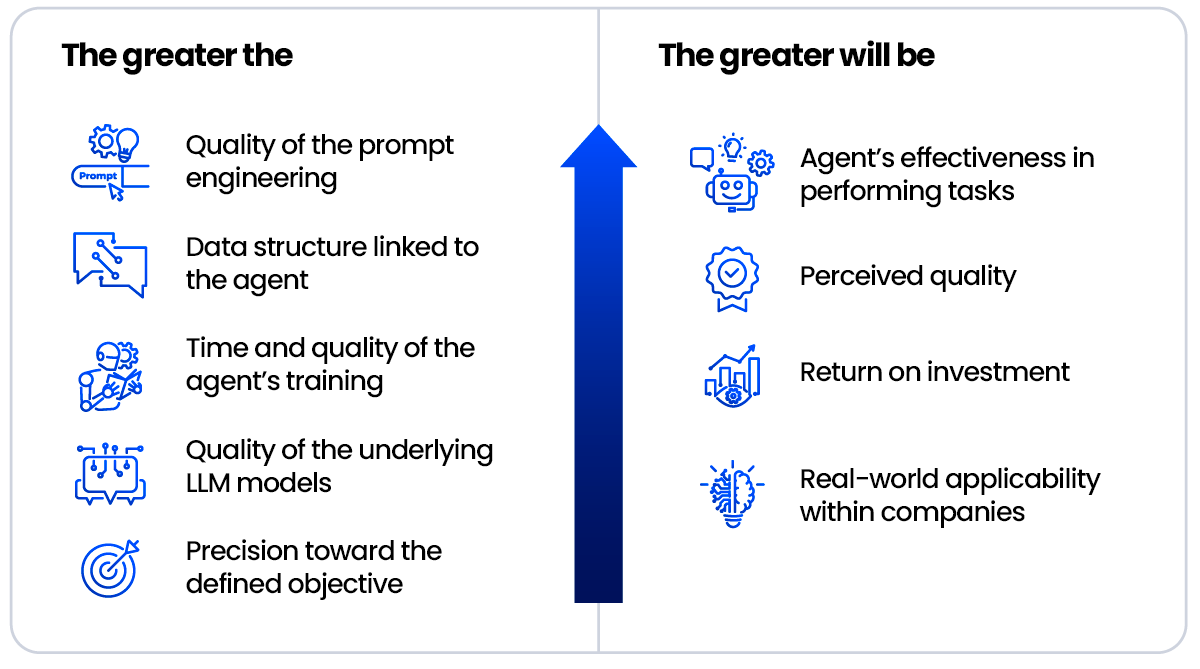
Source: Bridge & Co. 2025.
Use cases: possible applications for companies
1
Marketing
Intelligent agents are already being used across several areas of marketing, complementing human teams. They increase efficiency, reduce operational costs, and, in many cases, provide greater analytical capacity for decision-making.
Paid media analyst: an intelligent agent can be configured to monitor, in real time, the performance of paid campaigns on Google, LinkedIn, or Instagram. The agent can be assigned a specific mission, such as driving engagement or expanding the follower base. Once properly configured and integrated with the necessary databases and APIs, it can autonomously reallocate paid traffic investment from one platform to another without human intervention, acting independently to maximize the requested return. Today, this can already be done in a fully autonomous manner.
2
Human Resources
Recruitment and selection assistant: an intelligent agent can be configured to read résumés, identify key skills required for a position, rank candidates, flag potential risks, and populate a shortlist for final evaluation — which may be conducted by another agent or by a human supervisor. In a multi-agent operation, the entire process — from the initial screening to scheduling interviews for shortlisted candidates — can be managed entirely by intelligent agents.
3
Legal
Contract analyst: this type of agent can be trained to identify risks and deviations in contract drafts based on examples. During its training process, it learns what is mandatory for the company and which templates it should follow. Upon detecting deviations — according to the parameters defined in its prompt — it can autonomously request revisions or even make the necessary adjustments. The more integrated it is with other systems, the greater its ability to connect with the company’s procurement, contracting, and recruitment processes.
4
Finance
Fraud analyst: the agent can monitor a large volume of financial transactions in real time and identify suspicious activities. Through continuous learning, it improves its ability to distinguish between fraudulent behavior and false positives. With its autonomy, it can make decisions such as blocking transactions, requesting authenticity verifications, and initiating approval flows. The more integrated its architecture is with internal systems, the higher its level of agency will be.
Conclusion
The development of this new agentic workforce will increasingly require less programming knowledge. Low-code intelligent agent platforms enable a wide range of professionals to become capable of designing and deploying these agents.
However, there are inherent risks. It is essential for all involved to understand that an intelligent agent operates with autonomy. Unlike an RPA robot, it will produce variable results due to the probabilistic nature of the generative AI models it employs — which can sometimes lead to hallucinations or deviations from expected outcomes.
* Prompt Engineering is the set of best practices used to provide instructions to a Generative Artificial Intelligence system. Since most Generative AIs can be activated through natural language, it is essential to know how to maximize the likelihood of obtaining accurate outputs by choosing appropriate words, expressions, and guidelines.
Many people assume that it is enough to write something like “create an image of a man playing the piano” for an AI to generate a perfect result. However, the outputs are often random. To achieve greater precision, it is necessary to provide detailed instructions regarding scope, intentions, exceptions, examples, and other aspects.
Therefore, Prompt Engineering encompasses a collection of rules and guidelines that help structure natural language commands more effectively, enabling users to extract the maximum value from the AI model being used.