

AI and Data Intelligence Applications in the retail sector

What are Intelligent Agents and their main applications?
Expanding markets and creating new products and services remain top strategic priorities for organizations. In a recent Gartner® study on priority areas for the 2022/2023 cycle, 51% of respondents highlighted expansion as a key focus for their organizations.
Today, the challenge of reinventing a business is directly tied to understanding the customer — and how products or services fit into their journey. Unsurprisingly, the topics of “Products and Services” and “Consumers” have both gained relevance, growing 43% and 26% respectively compared to 2021.
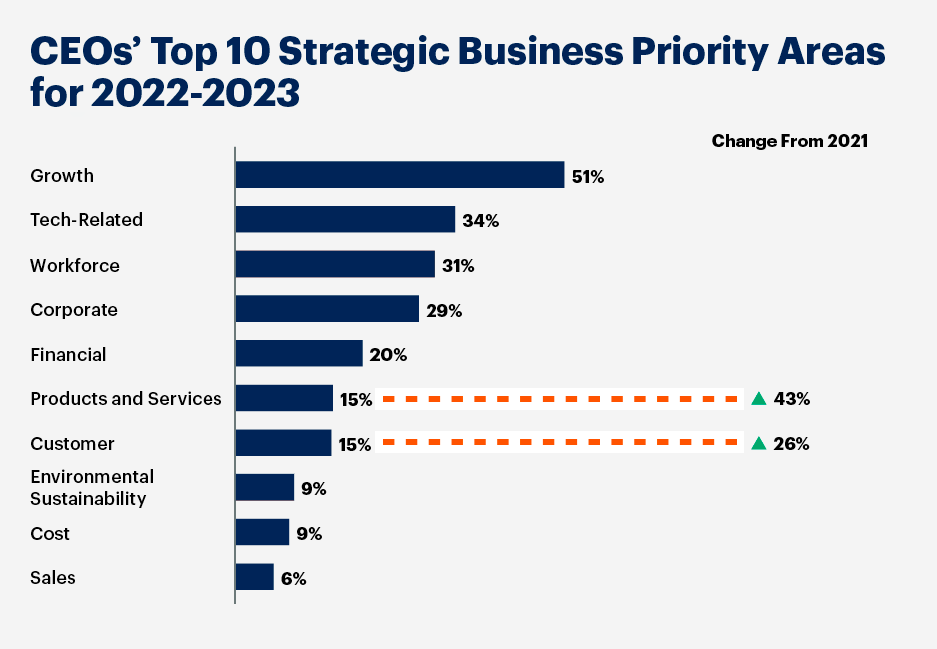
Source: Adapted from CEOs Turn a Sharp Eye to Workforce Issues and Sustainability in 2022-23, Gartner®.
Terms like “Customer Experience”, “Customer Centricity” and “UX” are increasingly common in strategic discussions and in product and service development within organizations. These discussions focus on placing the customer at the center of business strategy — understanding their characteristics, journeys, and needs.
According to Gartner®, Customer Centricity — the most comprehensive of these concepts — is about developing the ability to understand customers’ perceptions, expectations, and lived experiences. After all, they are the primary beneficiaries of the solutions organizations create and of the value these solutions deliver. Therefore, the entire organization must align its activities and decision-making to create value for the customer.
When combined with agile methods, a customer-focused strategy can be a powerful driver of more innovative and disruptive products and services. However, this transformation depends heavily on cultural change — a challenge that’s often underestimated.
Through our experience leading process, product, and service improvement projects, we’ve identified common challenges organizations face when adopting a customer-oriented mindset. Below, we share the main ones:
1
Strategy deployment
We have noticed that while many organizations aim to focus on the customer at the strategic level, this focus doesn’t always materialize tactically. Middle management often struggles with translating high-level goals into action — whether due to conflicting priorities or a lack of preparation to plan effectively and adaptively.
The Cone of Uncertainty illustrates that, at the tactical level, there’s still considerable ambiguity about what should be delivered. Yet, some level of predictability is necessary to guide work and set clear commitments.
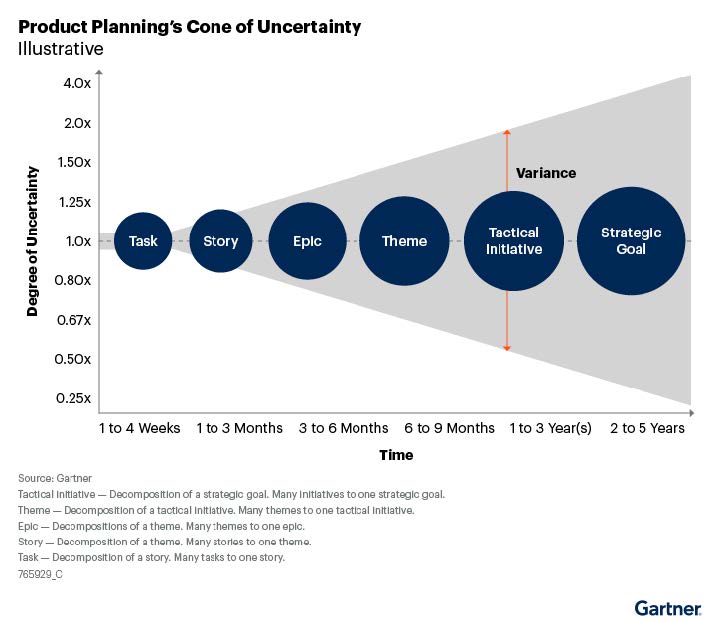
Source: Avoiding Audience Disappointment in Product Roadmap Delivery, 2022, Gartner®.
This difficulty in defining deliverables and reporting progress can lead to pressure for predictive reporting, which reduces flexibility and limits the ability to incorporate customer feedback and adapt.
How to address it?
At the tactical level, it is essential to establish clear guidelines for how products or services will be developed based on corporate objectives. This alignment must be structured and transparent to ensure effective operational execution.
A tool that remains underused by organizations adopting agile and customer-centric approaches is the roadmap. A roadmap helps define medium-term time horizons, set key milestones, and clarify major objectives — guiding priorities over time.
Ideally, a roadmap shouldn’t extend too far into the future and should be updated regularly. A timeframe of one to three years is recommended, depending on how volatile the market is for the product or service in question.
2
Challenges in understanding the customer’s voice
Another common challenge is truly putting oneself in the customer’s shoes — or even working directly with them to understand their needs. While “putting the customer at the center” sounds simple in theory, during workshops or brainstorming sessions, discussions often revolve around existing internal processes, tools, and structures rather than the customer’s actual experience.
As a result, improvements tend to focus on optimizing current workflows rather than creating meaningful or disruptive change.
How to address it?
Use tools like the empathy map to better understand customer behavior — what they feel, think, say, and do. This helps identify underlying needs and translate them into actionable goals and initiatives.
Complement this with the customer journey map, which visualizes how a customer interacts with a product or service throughout their experience. This map should detail every interaction, touchpoint, thought, and emotion — helping identify improvement opportunities and potential pain points. Ideally, the journey map should be visual, collaborative, and dynamic, incorporating diverse perspectives across teams.
3
Aligning internal processes and organizational structure
We also observe that many organizations struggle with rigid internal processes and structures that make it difficult to evolve customer-focused initiatives. Often, companies assume that only customer-facing areas need flexibility — overlooking the fact that organizations are complex, interdependent systems.
Even with excellent customer service, user-friendly platforms, or strong communication channels, inefficiencies in back-office processes can still negatively affect the customer experience. It’s essential to examine all areas that impact the customer journey, directly or indirectly.
How to address it?
Evaluate how all departments contribute to delivering customer value — not just their isolated outputs. Shift the focus from departments to value streams, ensuring collaboration across organizational boundaries.
Encourage creativity and engagement across teams — not only in creating customer solutions but also in rethinking how the organization itself can better support those solutions.
4
Measuring results
Finally, one of the most overlooked aspects of customer-centric initiatives is measuring outcomes. During customer journey mapping or process redesign, measurement is often an afterthought. Once a project ends, teams disband and rarely revisit the initiative to assess its real impact.
Without proper evaluation, organizations miss opportunities for visibility, learning, and continuous improvement.
How to address it?
Define clear objectives, metrics, and timelines before implementing initiatives. Assign a partially dedicated team to monitor progress, advise operational teams, and make necessary adjustments.
Share results internally to promote transparency and strengthen a customer-focused culture across the organization.
Discover how Bridge & Co. can help your organization advance on its customer-centric journey.